
The Certificate Was the Problem, Not the Vaccine
In 2025, a senior management consultant missed a last-minute project in Angola. She had received her yellow fever vaccine years earlier and was fully protected. The visa application, however, required a valid International Certificate of Vaccination or Prophylaxis, and she could not locate hers before the submission deadline. The trip was cancelled. A qualified, immunised professional lost a significant client engagement because of a piece of paper she could not put her hands on at the right moment.
If you travel frequently for work, that story probably stings a little. It is not an unusual one.
For frequent business travellers, vaccination records are not medical admin to be filed away and forgotten. Properly maintained, they function as a professional clearance document. Neglected, they create a category of disruption that has nothing to do with your health and everything to do with your preparedness.
What a Vaccination Record Actually Does in a Business Travel Context
A vaccination record, when it is accurate and accessible, does several things at once. It confirms immunisation status for occupational health requirements. It satisfies visa application conditions where proof of vaccination is mandatory. It meets airline boarding requirements for certain routes. And it gives you the freedom to accept short-notice travel assignments without scrambling.
The most critical document in this context is the ICVP, the yellow fever certificate issued under the International Certificate of Vaccination or Prophylaxis framework. This is the gold standard in travel health documentation and the one most frequently requested at borders across sub-Saharan Africa, parts of South America, and other regions where yellow fever is considered endemic. Since the World Health Organisation updated its rules in 2016, ICVP certificates are now considered valid for life rather than for ten years. Even so, some immigration authorities continue to query older certificates, and the resulting delays at entry points are both avoidable and professionally embarrassing.
Beyond yellow fever, a well-maintained vaccination record will include dates and batch numbers for typhoid, hepatitis A, hepatitis B, meningitis ACWY, rabies prophylaxis, and any other vaccines relevant to your destinations. It will also flag which booster doses are due and when, so you are never caught mid-assignment wondering whether a five-year-old course still provides adequate cover.
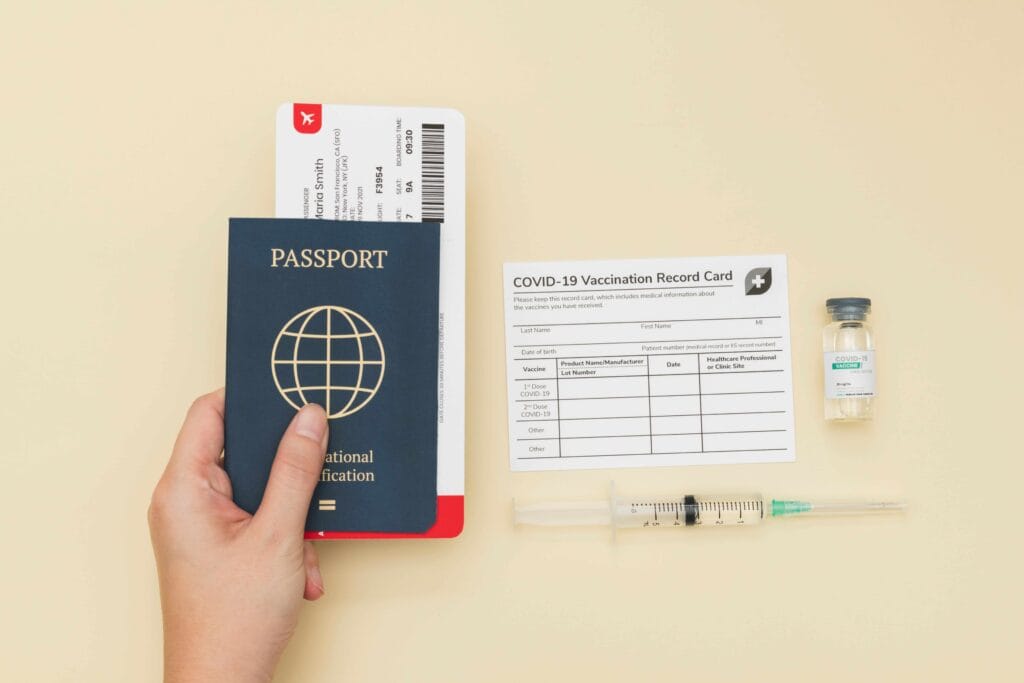
Where the Record Gaps Come From
Most frequent travellers do not have a single, consolidated vaccination record. They have fragments. A yellow fever certificate from a London travel clinic in 2019. Hepatitis A from a GP surgery before a trip to India. A typhoid top-up from a pharmacy in an airport. A meningitis ACWY jab arranged through an employer’s occupational health provider before a conference in Riyadh. Each of these is technically documented somewhere, but nowhere are they all together in a format you could present at a visa counter at 48 hours’ notice.
Add to this the widespread assumption that your GP holds everything. In practice, GP records are not always complete for vaccinations administered elsewhere, and they are certainly not retrievable outside of surgery hours on a Tuesday evening when you have just been told you need to be in Lagos by Friday. Digital NHS records have improved, but they remain inconsistent for travel vaccines specifically, which are often delivered privately.
There is also the booster timing problem. A pre-travel assessment carried out three years ago was accurate at the time. Since then, you may have needed a hepatitis B booster, a rabies top-up, or a repeat typhoid dose, depending on your destination pattern. If nobody has reviewed your cumulative history in the interim, those gaps exist whether you are aware of them or not.
The Professional Consequences of Documentation Failure
Denied boarding. Mandatory quarantine on arrival. Visa refusal. These are the worst-case outcomes, and they do happen. A traveller who arrives at Nairobi Jomo Kenyatta without evidence of yellow fever vaccination when arriving from a country where yellow fever is endemic faces a choice between a jab at the border (if available) or being turned around.
For professionals whose trips are tied to contract milestones, client board presentations, or time-sensitive negotiations, the financial consequence of a documentation failure extends well beyond any health cost. A missed week in Luanda on a construction consultancy project, a no-show at a pharmaceuticals procurement meeting in Accra, a cancelled site visit in Nigeria: these are not abstract risks. They carry invoiceable value and reputational weight.
The health risk is real and worth taking seriously on its own terms. But for your specific calculation as a frequent business traveller, the professional disruption is often the sharper concern.
A Simple Diagnostic for Your Own Record
Before your next trip is confirmed, run through these four questions honestly.
- Can you name the exact date of your last yellow fever vaccination and confirm you hold the original ICVP certificate?
- Do you know the booster schedule for every vaccine you have received in the last ten years, including hepatitis A, hepatitis B, typhoid, and any rabies course?
- Do you have a portable copy of your vaccination records that you can access outside of working hours without contacting a GP?
- Has a qualified travel health professional reviewed your cumulative vaccination history in the last two years?
If any answer is uncertain, you have a record gap. That gap represents friction on your next international trip, and it is entirely fixable before it becomes a problem.
How Healthpoint Closes the Gap
At Healthpoint’s travel vaccination clinics in Bewdley and Colwall, a travel health consultation is not simply about preparing for a single destination. For frequent business travellers, the more useful service is a consolidated vaccination record review: a structured assessment of everything you have received, identification of any booster doses coming due, and the issue of official documentation in a format that satisfies international entry requirements.
This kind of pre-travel assessment takes into account your typical travel pattern rather than just the next trip. If you move between West Africa, South Asia, and the Gulf regularly, the conversation about prophylaxis and documentation needs to reflect that range rather than being reset from scratch every time you book flights.
Appointments are structured to fit around working schedules, including Saturday availability, so a record review does not require you to take time out of client-facing commitments. The pharmacists at Healthpoint hold specialist travel health qualifications and work with up-to-date destination health risk guidance, meaning you receive advice calibrated to current conditions rather than generic protocols.
Ongoing booster reminders and maintained records mean that if a trip comes up at short notice, you can confirm your status quickly rather than spending three days trying to piece together certificates from three different providers.
Make Your Documentation as Ready as Your Itinerary
Frequent professional travellers plan meticulously. Flights, hotels, visa applications, ground transport, client briefings: everything on the itinerary is managed actively. Vaccination records deserve the same approach, not because the health risk has changed, but because the documentary risk is equally capable of cancelling a trip at the worst possible moment.
A single consolidated travel health consultation at Healthpoint can give you a clear picture of where your vaccination record stands, what needs updating, and what documentation you should be carrying. That clarity is worth considerably more than the time the appointment takes.